A Different Kind of Silence
ETERNAL ICE began as a personal project and grew into something we have returned to over many years. The Swiss glaciers offered a silence that was nothing like quiet. It was the presence of geological time, of ice that had accumulated over millennia and is now, within a single human lifetime, receding faster than it ever has before. For photographers who spend most of their working lives in industrial environments, that stillness was not peaceful. It was confrontational.
Before the Ice Is Gone
Switzerland has lost more than half of its glacier volume since the mid-nineteenth century, and the decline keeps accelerating. Since 2015 alone, a quarter of the remaining ice has disappeared: the steepest ten-year loss on record.
For ETERNAL ICE, we chose four glaciers that each tell a different part of this story:
Trift Glacier, Bernese Oberland
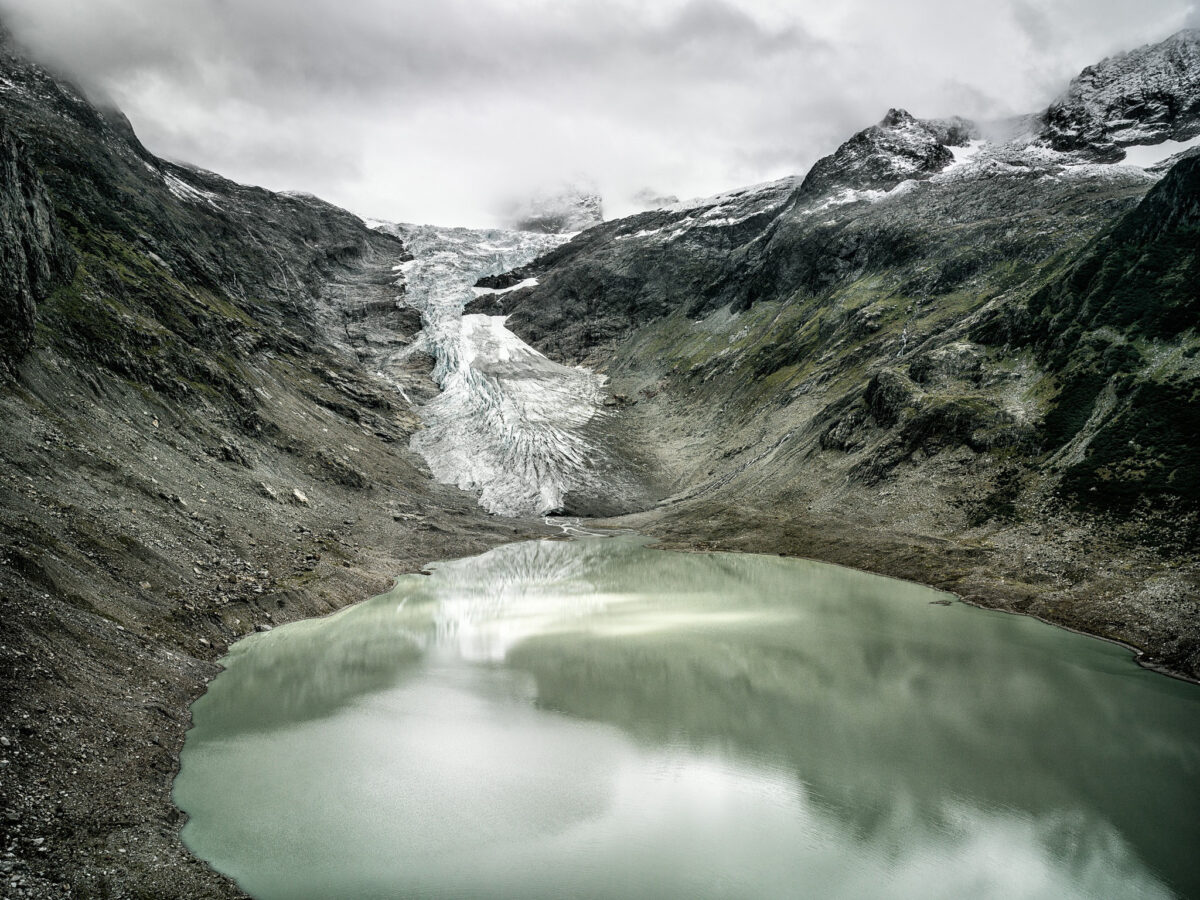
The approach to Trift is long and demanding. A hike that earns you the view. By the time you arrive, the effort of getting there has already set the scale of what you are looking at.
What struck us most was the glacier’s tongue, where the melting is most visible and most dramatic. The lake below it did not exist before 2002. It formed within a single generation, as the lower section of the glacier retreated and meltwater filled the space it left behind. Standing at its edge, that timeline is difficult to absorb. The water is cold and entirely new.
The Trift sits in the Susten-Grimsel region and has become one of the most cited examples of glacial retreat in Switzerland – losing metres of ice thickness each year, and frequently referenced in scientific studies and media as a measure of what is happening across the Alps. The suspension bridge above the lake, the mountain hut on the ridge: structures we built around a glacier that was already leaving. The landscape has reorganised itself around the loss. That reorganisation is not recovery.
Bernina Glacier, Graubünden
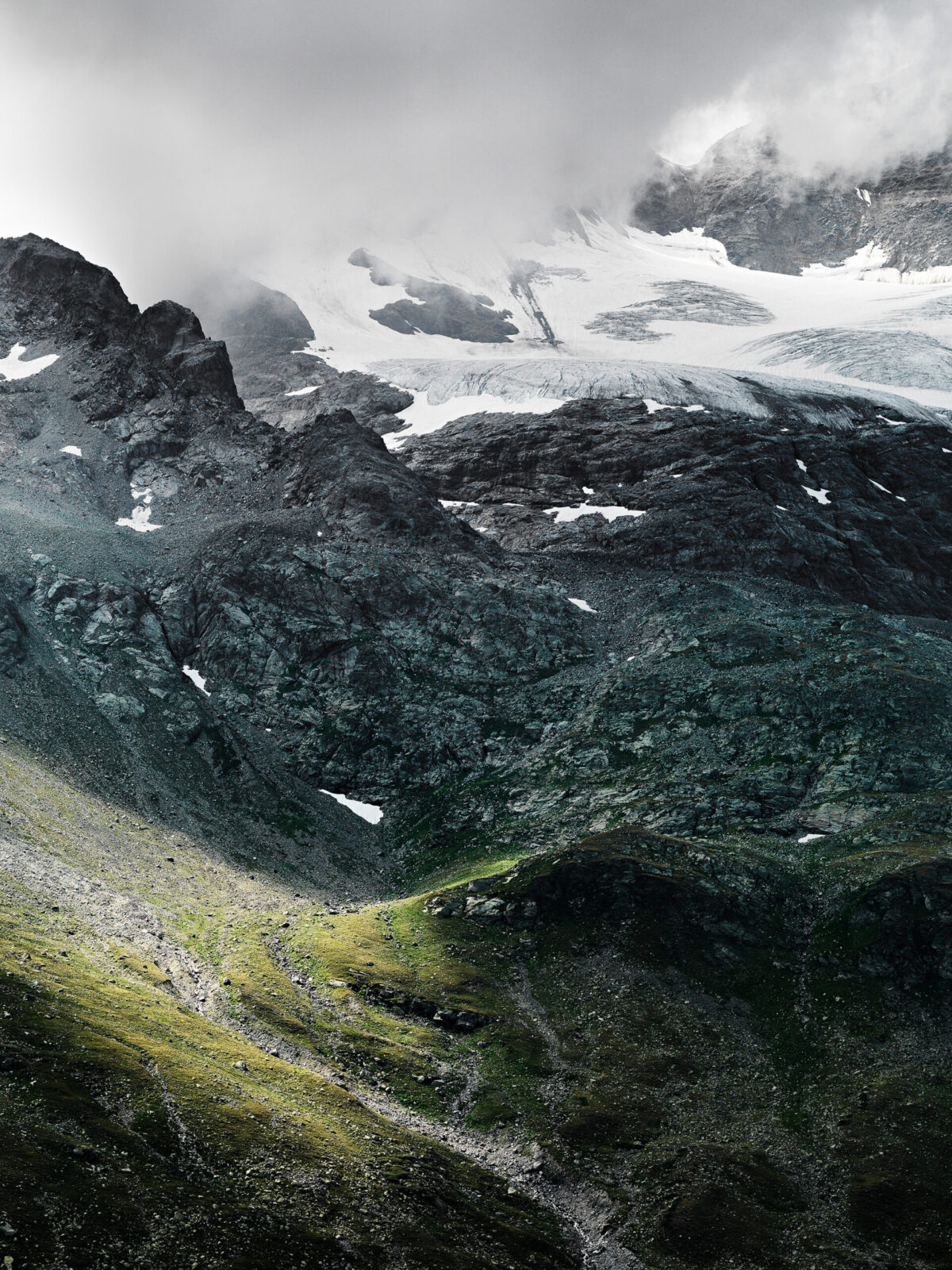
The Bernina Pass, at 2’328 metres, connects two worlds: the Engadin and the Italian-speaking Val Poschiavo. We have crossed it many times. It is one of those thresholds where the landscape shifts visibly – in light, in vegetation, in the quality of the air. And it is from this vantage point that the glaciers of the Bernina massif reveal themselves most fully.
Standing here, the documentation of glacial retreat becomes physical. Receding ice has exposed raw, recent-looking rock. We were drawn to the tension between the permanence of the mountain and the impermanence of what covers it – and to the way the pass itself, unchanged for centuries as a crossing point, now frames a landscape that is quietly, irreversibly different from the one travellers would have seen a hundred years ago.
Tschierva Glacier, Bernina Group, Graubünden
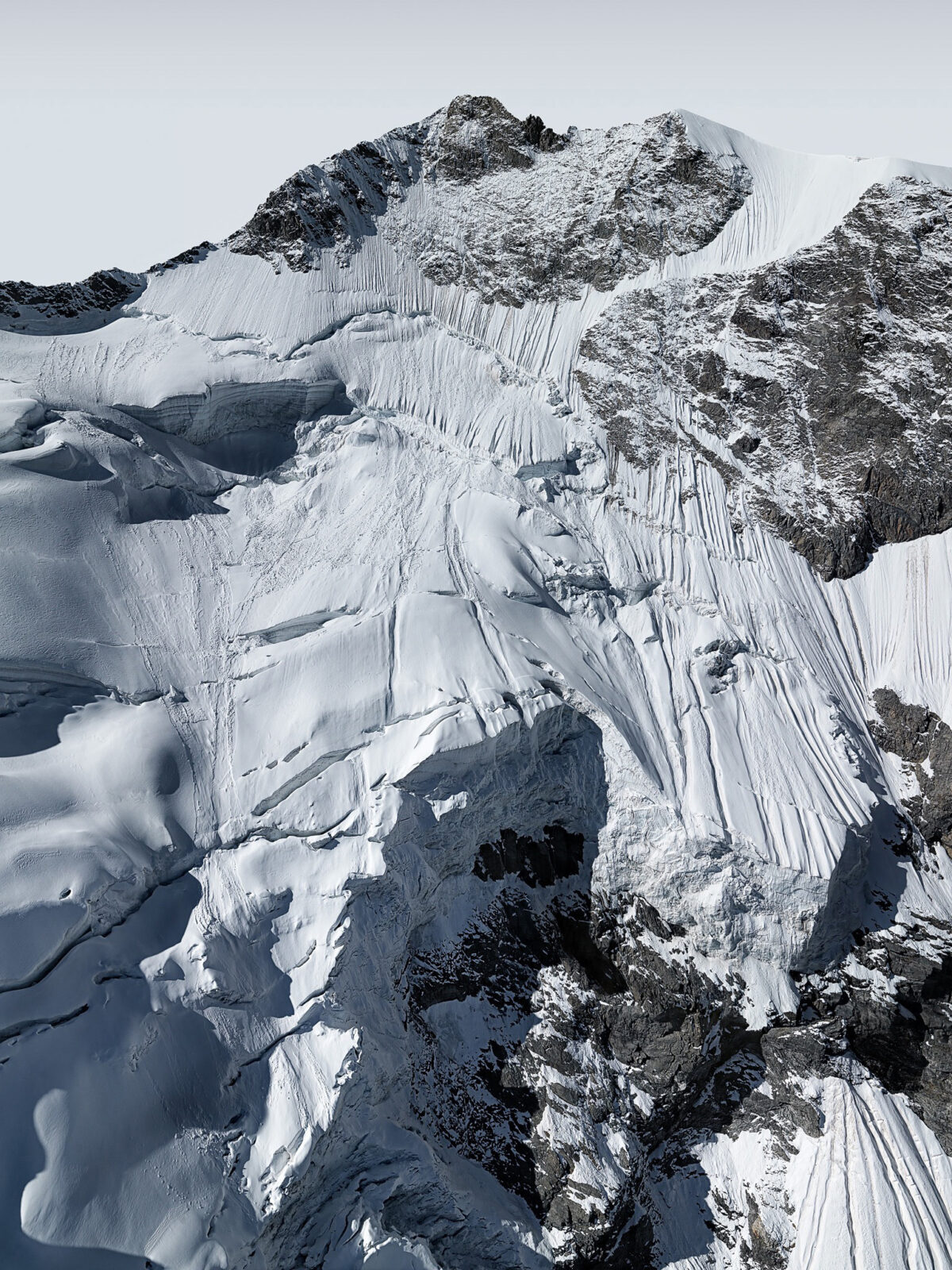
The Tschierva sits in the Val Roseg and can be reached only on foot. That distance is part of what the images hold.
At its peak during the Little Ice Age, around 1860, the Tschierva and the neighbouring Roseg glacier formed a single, unbroken stream of ice. By the early twentieth century, they had already begun to separate. Today, the volume of ice lost across Graubünden since that high point is roughly equivalent to the entire contents of Lake Zurich.
For the Tschierva image, we did not set out to document the glacier in a conventional sense. The photograph is a constructed landscape, made across a flight by helicopter: we combined several viewpoints and deliberately manipulated the perspective to bring the ice masses closer while pushing the surrounding rock faces and mountain flanks into the background. The aerial approach was not the most climate-neutral choice for a project about glacial loss. It is a contradiction we are aware of. The perspective it opened, and what it revealed about the scale of what is disappearing, felt worth the honesty of naming it. The result is a glacier that feels both present and already distant, a place that, as retreat continues, will soon exist only as a memory of this form.
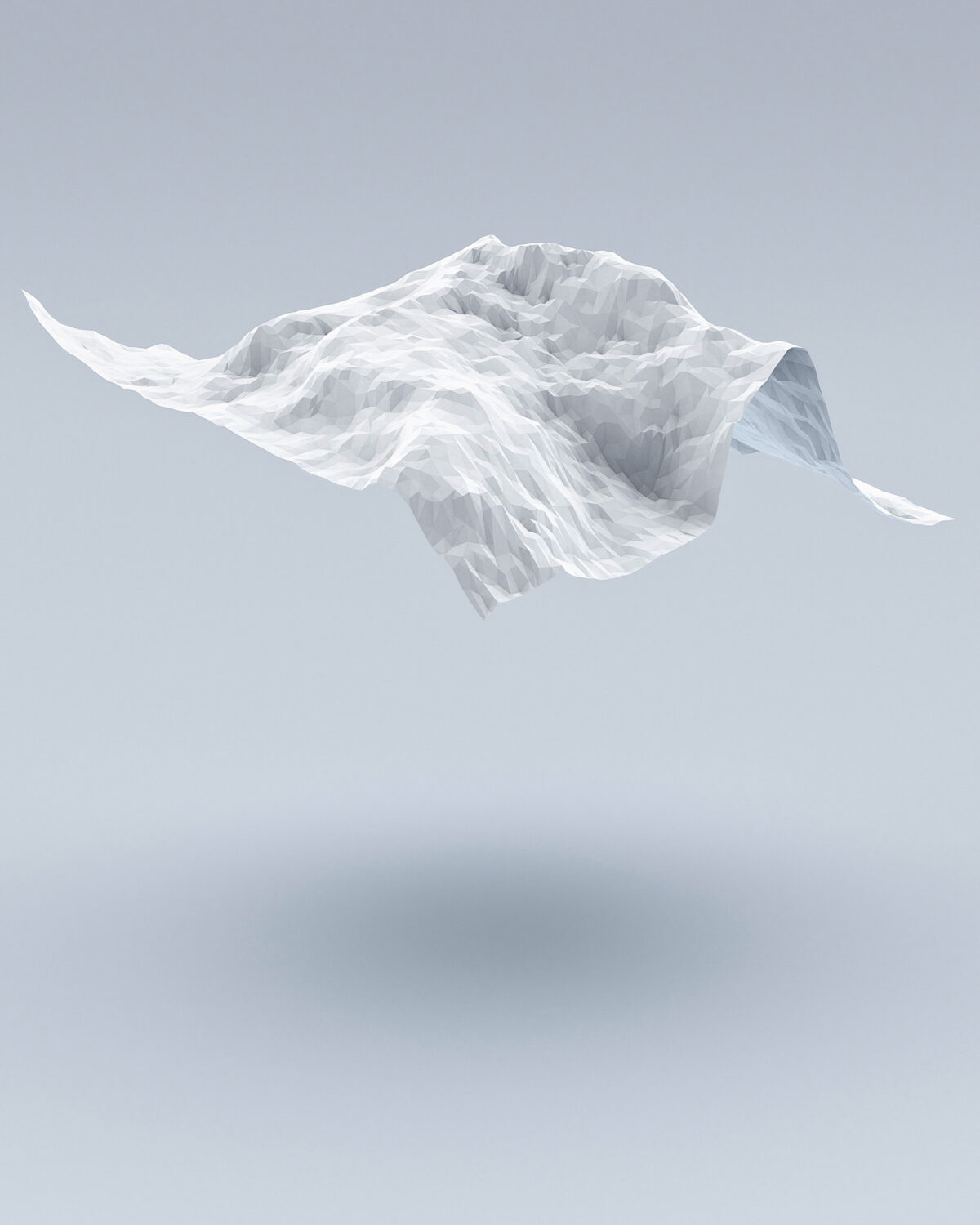
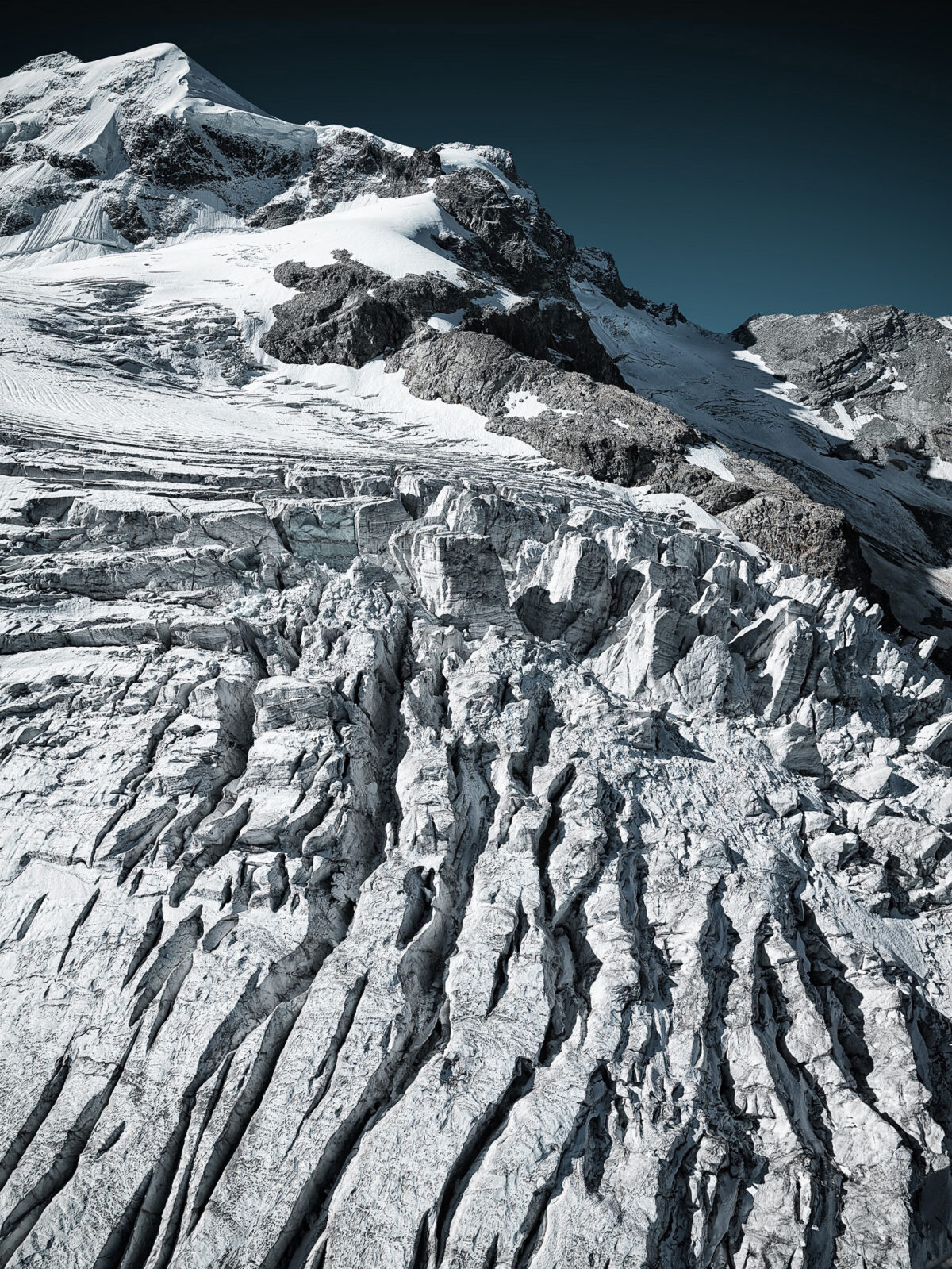
Tschierva Glacier, 2013
Rhône Glacier, Uri Alps
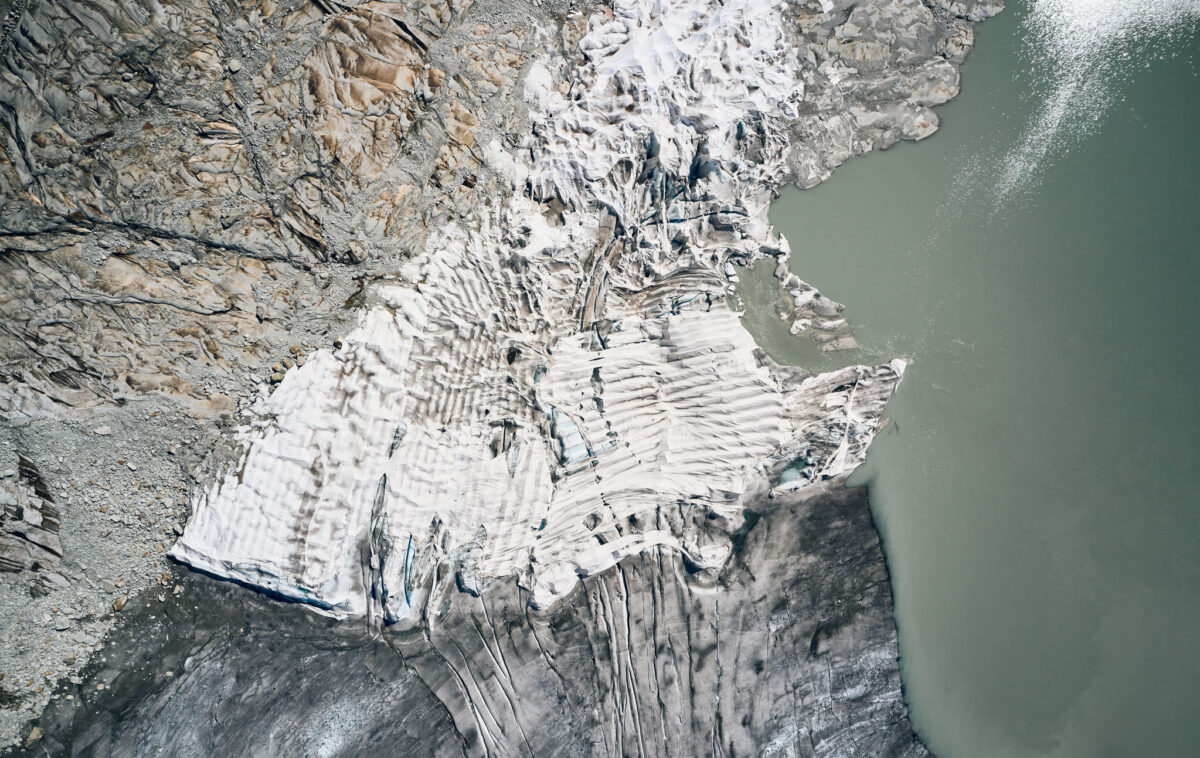
The Rhône glacier is the most visited in Switzerland, and the most visibly tended. Each summer, the team wraps sections of the ice in thick white insulating blankets to slow the melt around the glacier’s famous ice grotto – a cave that has to be re-excavated every year as the ice shifts and thins. The family who has managed this site for generations has watched their glacier, and their livelihood, change beyond recognition.
On the ground, the blankets feel like an act of devotion as much as logistics. Up close, they are torn and weathered, held down against wind and weather. Every year, the grotto moves a little further from the souvenir shop. Every year, it becomes a little shallower. It is only from the air that the full extent of this gesture becomes visible.
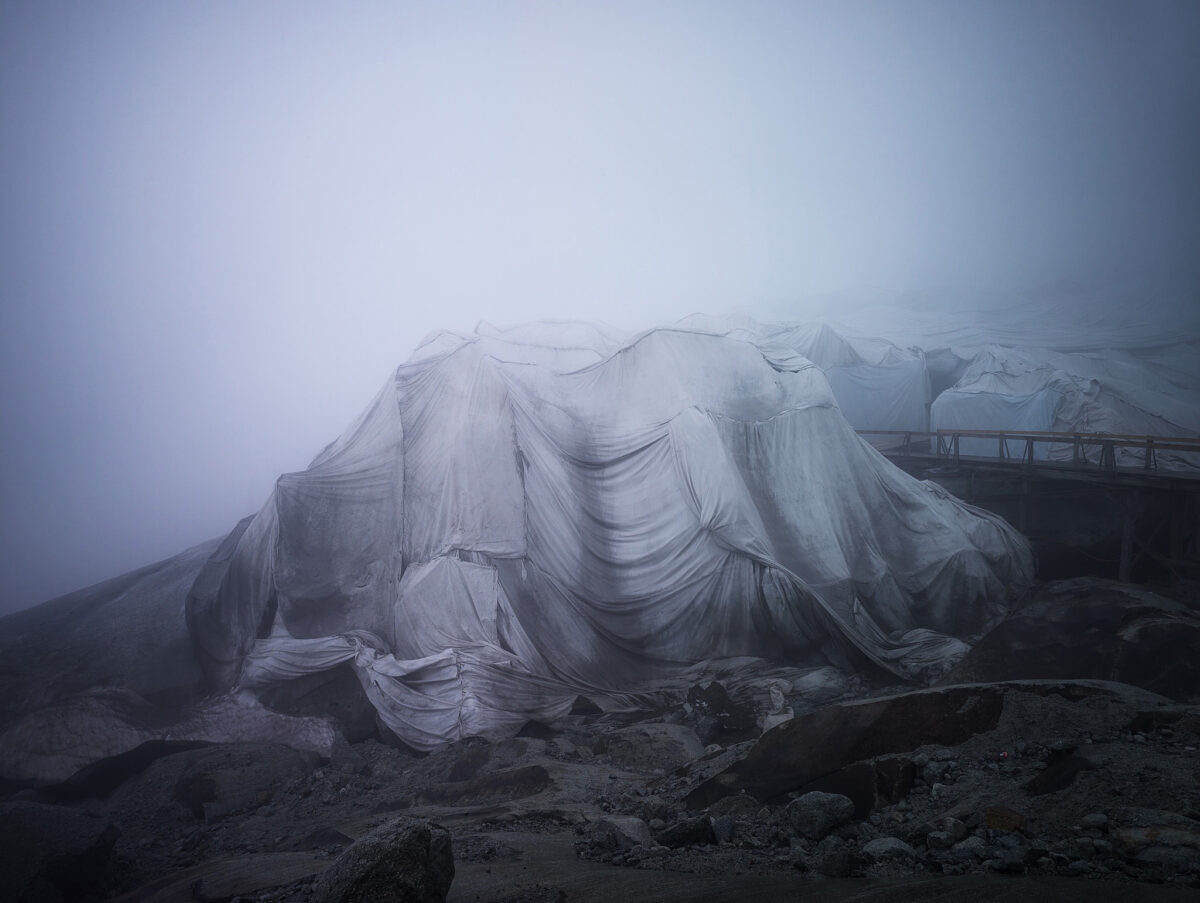
Rhône Glacier from the Air
From above, the blankets are small. The glacier is smaller still. We made the aerial photograph that opens this journal entry in 2021 by drone, for a collaborative mailing with Keller Maurer Design. From altitude, the white insulating blankets appear as pale patches against the grey-blue of the ice. What is intimate and almost tender on the ground becomes, from the air, a pattern. A symptom. Something that can be seen all at once.
The full mailing is available to view here.
Why We Made These Images
We are photographers, not scientists or campaigners. We made these images because looking closely, over a long time, was how we wanted to meet this. Each photograph required a specific decision: where to stand, what light to work in, what to include and what to leave out. The glaciers were there long before our cameras. The photographs are a record of the encounter.
Exhibitions
We have shown the ETERNAL ICE series in the following contemporary art contexts:
ETERNAL ICE
VOLTA contemporary art week, Basel, Switzerland
Group Exhibition, June 16–21, 2014
THE EYE OF THE VALLEY
Château Papillon des Arts, St. Moritz, Switzerland
Group Exhibition, November 21–24, 2013
SHAPE THE SCAPE
Widmer+Theodoridis contemporary, Zurich, Switzerland
Group Exhibition, Aug 29–Oct 19, 2013
THE EYE OF THE VALLEY
Gallery Idea Fixa, Basel, Switzerland
Group Exhibition, October 12–24, 2013
The ETERNAL ICE images are available as limited edition fine art prints, each produced to archival standards with a certificate of authenticity. For editions, formats, and pricing, write to Andreana directly.
To stay informed about new journal entries and projects, subscribe to our newsletter.